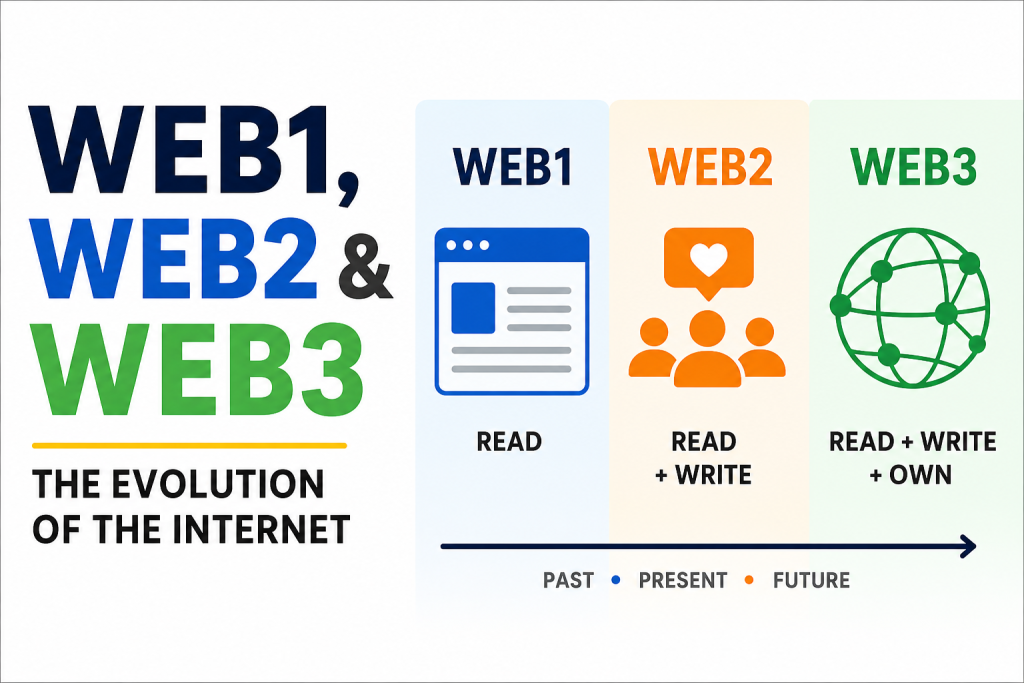
The internet has transformed dramatically over the past three decades. From simple websites that only displayed information to today’s interactive social media platforms and the emerging decentralized web, the internet has gone through three major stages: Web1, Web2, and Web3.
Understanding these stages helps us appreciate where the internet came from and where it is heading.
What is Web1?
Web1, often called the “Read-Only Web,” was the first generation of the internet, existing roughly between 1991 and 2004.
During this period, websites were static. Visitors could read information, but there was little or no interaction with the content.
Characteristics of Web1
- Static HTML websites
- One-way communication
- Limited multimedia
- No social media
- Few opportunities for users to create content
Examples
- Early Yahoo! Directory
- Britannica Online
- Personal websites
- Company information pages
Advantages
- Fast loading websites
- Simple design
- Low security risks
- Easy to build
Limitations
- No user interaction
- No commenting or sharing
- Very limited functionality
- Mostly informational
Think of Web1 as reading a digital newspaper—you could consume information, but you couldn’t participate.
What is Web2?
Web2 is known as the “Read-Write Web.” It began around 2004 and is the internet we use today.
Unlike Web1, Web2 allows users to create content, communicate, collaborate, and interact with one another in real time.
Today, billions of people use Web2 applications every day.
Characteristics of Web2
- Interactive websites
- User-generated content
- Social networking
- Mobile applications
- Cloud computing
- Online collaboration
Examples
- YouTube
- TikTok
- X (formerly Twitter)
- Google Docs
Advantages
- Easy communication
- Content creation by everyone
- Online learning
- E-commerce
- Digital marketing
- Video streaming
- Real-time collaboration
Limitations
- Users do not own their data
- Companies control platforms
- Privacy concerns
- Risk of account suspension
- Heavy dependence on advertisements
For example, when you post a photo on Facebook or upload a video to YouTube, the platform stores and controls your content, even though you created it.
What is Web3?
Web3 is the next generation of the internet, often referred to as the “Read-Write-Own Web.”
Its goal is to give users greater ownership of their digital identities, assets, and data through decentralized technologies such as blockchain.
Instead of relying on one company to control a platform, Web3 distributes control across many participants.
Characteristics of Web3
- Decentralization
- Blockchain technology
- Cryptocurrency payments
- Smart contracts
- Digital ownership
- Token-based economies
- Enhanced privacy
Examples
- Decentralized Finance (DeFi) platforms
- NFT marketplaces
- Decentralized Autonomous Organizations (DAOs)
- Blockchain-based games
- Decentralized storage services
Advantages
- Users own their digital assets
- Better privacy
- Reduced dependence on centralized companies
- More transparency
- Greater control over personal data
Challenges
- Complex for beginners
- Cryptocurrency price volatility
- Regulatory uncertainty
- Security risks if users lose private keys
- Slower adoption compared to Web2
Web1 vs Web2 vs Web3
| Feature | Web1 | Web2 | Web3 |
| User Role | Read | Read and Write | Read, Write, and Own |
| Content Creation | Website owners | Everyone | Everyone |
| Data Ownership | Website owners | Large technology companies | Individual users |
| Technology | HTML | Cloud computing, APIs, Social Media | Blockchain, Smart Contracts |
| Payments | Traditional banking | Traditional banking | Cryptocurrency and digital wallets |
| Control | Website owners | Centralized platforms | Decentralized networks |
Real-Life Example
Imagine opening a restaurant.
Web1
Customers can only read your menu online.
Web2
Customers can read the menu, leave reviews, upload photos, and interact with your business on social media.
Web3
Customers can also own digital membership tokens, earn rewards automatically through smart contracts, vote on special offers, and securely manage their own digital identity without relying entirely on a central platform.
Why Should Digital Marketers Learn About Web3?
As digital marketing continues to evolve, understanding Web3 can provide a competitive advantage.
Future marketers may work with:
- Blockchain communities
- NFT-based loyalty programs
- Cryptocurrency payments
- Decentralized advertising platforms
- Token-based customer rewards
- AI-powered decentralized applications
Although Web2 remains the dominant internet today, many businesses are already exploring Web3 technologies to prepare for the future.
Conclusion
The internet has evolved from Web1 (Read) to Web2 (Read and Write) and is gradually moving toward Web3 (Read, Write, and Own).
Each generation has introduced new opportunities for businesses and individuals. While Web1 focused on sharing information and Web2 emphasized interaction and collaboration, Web3 aims to give users greater ownership, privacy, and control over their digital lives.
Whether you are a business owner, student, developer, or digital marketer, understanding these three stages will help you stay ahead as the internet continues to evolve.
